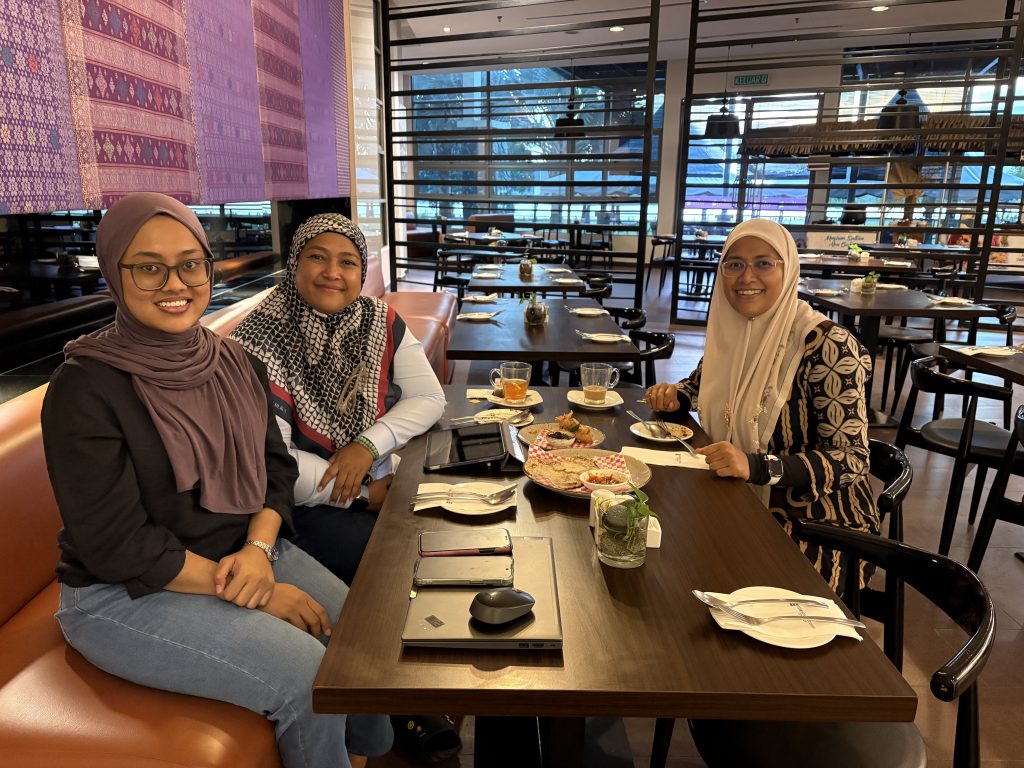
Finally, after 2 years – come back and stronger!
Category: Uncategorized
Discussion UMPSA STEM Lab Chumbaka


Discussion Senior Design Project 2

Discussion CMU UMPSA STEM Lab PIE IV


Discussion BHE Program SEMSAS
Forum AI from Religious Perspective

The highlight of the Teaching & Learning Symposium 2025 at Universiti Malaysia Pahang Al-Sultan Abdullah (UMPSA) was an interdisciplinary forum titled “Integrating Values in the Age of AI — Insights from Religious Perspectives.” The session brought together international and local scholars to engage in a deep, cross-cultural dialogue on how artificial intelligence (AI) intersects with human values, ethics, and spirituality.
The distinguished panelists included Dr. Mike Brownnutt from The Faraday Institute for Science and Religion, University of Cambridge; Prof. Dr. Esyin Chew from Cardiff Metropolitan University; Dr. Irfan from the Pusat Kemanusiaan, UMPSA; and Dr. Nurul Hazlina, also from UMPSA. The discussion was moderated by Dr. Nurul Noordin, Director of the UMPSA STEM Lab.
The session stood out not only for its diversity of viewpoints but also for the depth of ethical reflection it inspired. The panel examined the question of how religious wisdom traditions can inform the ethical design and use of AI technologies that are increasingly shaping our everyday lives — from classrooms to hospitals to decision-making systems.
Representing the Islamic viewpoint, Dr. Irfan underscored the importance of authenticity and verification in the age of information. He drew a parallel between the Islamic scholarly tradition of verifying hadith and fatwa with the contemporary need to critically evaluate AI-generated content.
According to Dr. Irfan, just as Islamic scholars meticulously examine the chain of narrators (sanad) and content (matan) before authenticating a hadith, educators and users must adopt a similar intellectual discipline when engaging with AI outputs. He emphasized that intention (niyyah), accuracy, and responsibility remain the ethical anchors of any knowledge pursuit, whether derived from human or machine sources. AI, he reminded the audience, should be viewed not as an infallible authority, but as an instrument to assist human reasoning and moral judgment.
From the philosophical perspective, Dr. Mike Brownnutt provided a thoughtful critique of how technology might unintentionally erode the process of human moral and intellectual reflection. He noted that while AI offers immense efficiency and access to knowledge, it risks simplifying complex human experiences and moral dilemmas.
Dr. Brownnutt argued that moral growth and spiritual discernment are formed through a process — one that involves questioning, dialogue, and contemplation. When AI provides instant answers or solutions, it may short-circuit this essential process, diluting the depth of understanding that underpins human wisdom. He urged educators, technologists, and policymakers to ensure that AI remains a servant to human discernment, not a substitute for it.
Adding a practical dimension to the discussion, Prof. Dr. Esyin Chew shared insights from her research in digital education and healthcare. She elaborated on how AI is increasingly being embedded within systems of care, learning, and communication — not merely as a tool but as a medium of collaboration between humans and machines.
Prof. Chew illustrated how AI technologies can enhance empathy in healthcare — assisting in diagnosis, improving accessibility, and supporting emotional well-being. She linked these developments to education, where AI can similarly serve as a bridge between teachers and learners, enriching pedagogical practices. However, she emphasized that this integration must always be guided by values, ensuring technology enhances human connection rather than replacing it.
The conversation among the panelists converged on a shared understanding: while AI holds tremendous potential, it must be developed and deployed within the framework of enduring human values — truth, compassion, accountability, and respect for human dignity.
The forum became a rare and profound meeting point between science, technology, and spirituality. It reminded participants that innovation without ethics can lead to alienation, but when guided by moral and religious insights, AI can become a force for human flourishing.
This thought-provoking session was made possible through the British Council PIE-WISE Grant, a collaborative initiative led by Cardiff Metropolitan University (UK) and UMPSA (Malaysia). The grant aims to foster intellectual exchange, strengthen international collaboration, and promote culturally informed discussions on technology, pedagogy, and ethics.
The forum exemplified how such partnerships can create platforms where faith and science coexist — not in opposition, but in dialogue — guiding humanity toward a future where technology serves, rather than defines, the essence of being human.


Pre-Viva


Discussion Novel Material for Antenna

Module Development AI Chip


Discussion MDEC